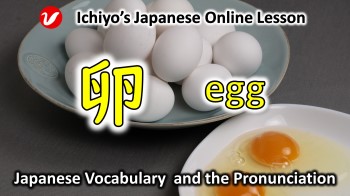
The Japanese vocabulary「卵 (たまご、tamago)」means “egg.” Please learn the pronunciation and the example sentences.
Japanese Vocabulary and the Meaning
| Key Word | 卵 | 生卵 |
| Hiragana | たまご | なまたまご |
| Romaji Reading | tamago | nama-tamago |
| English Meaning | egg | raw egg |
| ゆで卵 | 半熟卵 |
| ゆでたまご | はんじゅくたまご |
| yude tamago | hanjuku-tamago |
| hard-boiled egg | soft-boiled egg |
The Correct Japanese Pronunciations
Please learn the pronunciation by watching the attached video. You can also learn example sentences.
Our YouTube channel: Ichiyo’s Japanese YouTube Channel
The Example Japanese Sentences
It is important to have skills in both non-honorific and honorific languages in order to use Japanese correctly.
I’ll boil the eggs in a pot.
Plain form:
卵を鍋で茹でる。
Tamago o nabe de yuderu.
Polite form:
卵を鍋で茹でます。
Tamago o nabe de yudemasu.
I dropped the egg on the floor.
Plain form:
卵を床に落とした。
Tamago o yuka ni otoshita.
Polite form:
卵を床に落としました。
Tamago o nabe de yudemasu.
I cut the hard-boiled egg in half. (Past)
Plain form:
ゆで卵を半分に切った。
Yude tamago o hanbun ni kitta.
Polite form:
ゆで卵を半分に切りました。
Yude tamago o hanbun ni kirimashita.
I’ll peel the shell of the boiled egg.
Plain form:
ゆで卵の殻を剥く。
Yude tamago no kara o muku.
Polite form:
ゆで卵の殻を剥きます。
Yude tamago no kara o mukimasu.
I’ll mash the boiled eggs and mix them into the salad.
Plain form:
ゆで卵を潰してサラダに混ぜる。
Yude tamago o tsubushite sarada ni mazeru.
Polite form:
ゆで卵を潰してサラダに混ぜます。
Yude tamago o tsubushite sarada ni mazemasu.
I’ve never eaten raw eggs.
Plain form:
生卵を食べたことはない。
Namatamago o tabeta koto wa nai.
Polite form:
生卵を食べたことはありません。
Namatamago o tabeta koto wa arimasen.
Soft-boiled eggs are ready.
Plain form:
半熟卵ができた。
Hanjuku tamago ga dekita.
Polite form:
半熟卵ができました。
Hanjuku tamago ga dekimashita.