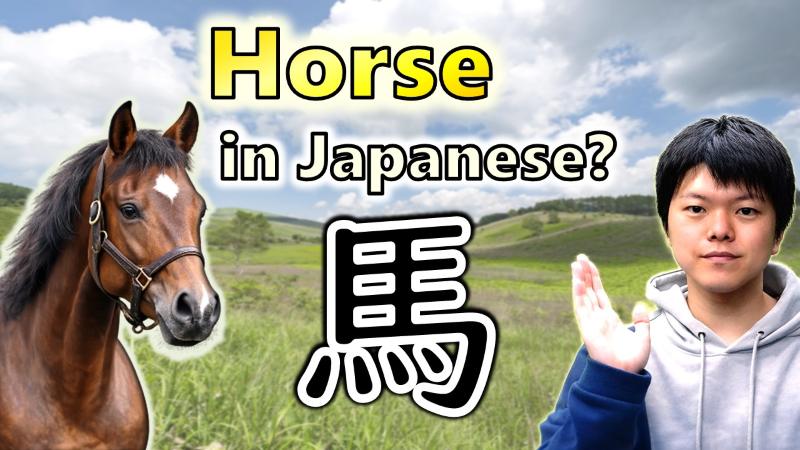
Do you know how to say “horse” in Japanese?
In Japanese, “bear” is Horse in Japanese: 馬 (うま / uma).
In this article, you’ll learn its meaning, pronunciation, and how to use it in example sentences.
Our YouTube channel: Ichiyo’s Japanese Channel
Japanese Vocabulary and the Meaning
| Key Word | 馬 / ウマ |
| Hiragana | うま |
| Romaji Reading | uma |
| English Meaning | horse |
The word can be written in kanji, hiragana, or katakana, but in most cases it’s written in kanji.
How to Pronounce Horse in Japanese
Pronunciation: 馬(うま / uma)
🔊 Listen:
This audio is for personal learning purposes only.
Please do not reuse or redistribute it without permission.
To avoid developing incorrect pronunciation,
we recommend practicing with a teacher.
👉 Join Ichiyo’s Japanese Online Lesson
The Example Japanese Sentences
It is important to have skills in both non-honorific and honorific languages in order to use Japanese correctly.
I rode a horse on a farm.
Plain form:
牧場で馬に乗った。
Bokujō de uma ni notta.
Polite form:
牧場で馬に乗りました。
Bokujō de uma ni norimashita.
The horse is sleeping comfortably.
Plain form:
馬が気持ち良さそうに寝ている。
Uma ga kimochi-yosasō ni nete iru.
Polite form:
馬が気持ち良さそうに寝ています。
Uma ga kimochi-yosasō ni nete imasu.
The bear caught a big salmon.
Plain form:
馬がニンジンを欲しがっている。
Uma ga ninjin o hoshi gatte iru.
Polite form:
馬がニンジンを欲しがっています。
Uma ga ninjin o hoshi gatte imasu.
It’s cool to see horses running.
Plain form:
馬が走る姿は、かっこいい。
Uma ga hashiru sugata wa, kakkoī.
Polite form:
馬が走る姿は、かっこいいです。
Uma ga hashiru sugata wa, kakkoī.
A horse is eating hay.
Plain form:
馬が、干し草を食べている。
Uma ga hoshikusa o tabete iru.
Polite form:
馬が干し草を食べています。
Uma ga hoshikusa o tabete imasu.
My wife and my mother seem to hit it off..
馬が合う= hit it off
Plain form:
嫁と私の母は、馬が合うようだ。
Yome to watashi no haha wa uma ga au yōda.
Polite form:
嫁と私の母は馬が合うようです。
Yome to watashi no haha wa uma ga au yōdesu.
Ready to speak Japanese more naturally?
Ichiyo’s Japanese Online Lesson offers personalized one-to-one online lessons for all levels.
👉 Learn Japanese with a native teacher Ichiyo • Teacher