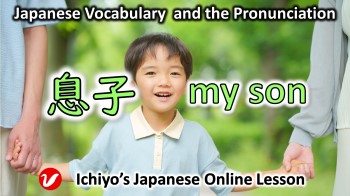
The Japanese vocabulary「息子 (むすこ、musuko)」means “my son.” Please learn the pronunciation and the example sentences.
Japanese Vocabulary and the Meaning
| Key Word | 息子 |
| Hiragana | むすこ |
| Romaji Reading | musuko |
| English Meaning | my son |
The Correct Japanese Pronunciations
Please learn the pronunciation by watching the attached video. You can also learn example sentences.
The Example Japanese Sentences
It is important to have skills in both non-honorific and honorific languages in order to use Japanese correctly.
| Japanese Sentence | 明日は息子とキャッチボールをする。 |
| Romaji Reading | Ashita wa musuko to kyatchibōru o suru. |
| English Meaning | I will play catch with my son tomorrow. (Plain Form) |
| Japanese Sentence | 明日は息子とキャッチボールをします。 |
| Romaji Reading | Ashita wa musuko to kyatchibōru o shimasu. |
| English Meaning | I will play catch with my son tomorrow. (Polite Form) |
| Japanese Sentence | 雨の日だけは、息子を学校まで迎えに行く。 |
| Romaji Reading | Ame no hi dake wa, musuko o gakkō made mukae ni iku. |
| English Meaning | I pick up my son from school only on rainy days. (Plain Form) |
| Japanese Sentence | 雨の日だけは、息子を学校まで迎えに行きます。 |
| Romaji Reading | Ame no hi dake wa, musuko o gakkō made mukae ni ikimasu. |
| English Meaning | I pick up my son from school only on rainy days. (Polite Form) |
| Japanese Sentence | あの緑の帽子を被っている子が私の息子だ。 |
| Romaji Reading | Ano midori no bōshi o kabutte iru ko ga watashi no musuko da. |
| English Meaning | That child wearing a green hat is my son. (Plain Form) |
| Japanese Sentence | あの緑の帽子を被っている子が私の息子です。 |
| Romaji Reading | Ano midori no bōshi o kabutte iru ko ga, watashi no musuko desu. |
| English Meaning | That child wearing a green hat is my son. (Polite Form) |